dayileyvasOctober 1, 20263 Mins read27
Operation Saturday Night Fever Puts 78 Drivers Out of Service
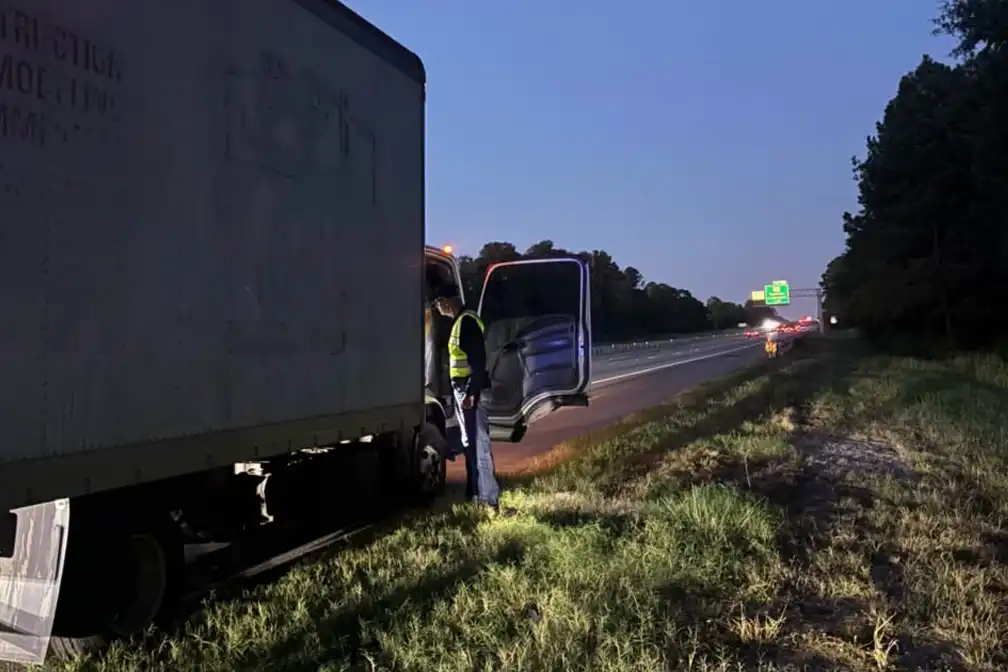
A coordinated overnight commercial vehicle enforcement operation across four Southeastern states resulted in 78 drivers and 25 vehicles being placed out of service. The FMCSA joined state law enforcement and the DHS for Operation Saturday Night Fever on Saturday, September 26.
The enforcement effort covered South Carolina, North Carolina, Georgia and Florida. Inspectors focused on major freight corridors, including Interstate 95.
Officials checked commercial drivers and vehicles for a wide range of safety and regulatory violations. The operation included checks for driver credentials, fatigue, electronic logging devices, distracted driving, cargo securement and English-language proficiency.
Operation Saturday Night Fever Targets Four States
Operation Saturday Night Fever is a periodic nighttime commercial vehicle enforcement effort led by the South Carolina State Transport Police.
The September 26 operation marked the third such enforcement initiative in South Carolina during 2026. However, it was the first to expand into multiple states through coordination with FMCSA and law enforcement agencies in North Carolina, Georgia and Florida.
South Carolina deployed 70 State Transport Police officers across its interstate system. At the same time, enforcement agencies in the other three states conducted inspections along the I-95 corridor.
Officials said nighttime enforcement allows agencies to focus on violations that may occur during late-night and early-morning operations.
South Carolina State Transport Police Col. Dwayne Wilson said those hours can be periods when dangerous driving behaviors go unnoticed.
78 Commercial Drivers Placed Out of Service
FMCSA reported that officers conducted 552 commercial vehicle inspections during Operation Saturday Night Fever.
Those inspections resulted in:
- 78 drivers placed out of service
- 25 vehicles placed out of service
- 12 drivers placed out of service for English-language proficiency violations
FMCSA also said some drivers inspected during the operation held non-domiciled CDLs. However, the agency did not provide a number showing how many non-domiciled CDL holders were inspected or placed out of service.
South Carolina DPS reported the same driver and vehicle out-of-service totals but listed 568 inspections, rather than FMCSA’s 552. The state agency also reported 173 moving violations and seven criminal arrests. The arrests included alleged offenses involving driving under suspension and possession or trafficking of controlled substances.
Neither release explains the difference between the two inspection totals.
Inspectors Checked ELDs, Fatigue and Vehicle Safety
The enforcement operation went beyond standard vehicle inspections.
According to FMCSA, investigators and law enforcement officers verified driver credentials and checked for fatigue, ELD compliance, distracted driving and unsecured cargo.
South Carolina DPS provided additional detail, saying enforcement included checks for ELD manipulation, mechanical deficiencies, impaired driving and other violations affecting commercial vehicle safety.
The operation also included English-language proficiency checks.
Federal regulations require commercial motor vehicle drivers subject to the rule to have sufficient English proficiency to communicate with the public, understand highway signs, respond to official questions and complete required reports and records.
Twelve drivers were placed out of service for English-language proficiency violations during the operation.
English Proficiency Enforcement Remains a Focus
English-language proficiency has received increased federal enforcement attention since President Donald Trump issued an executive order in April 2025 directing enforcement of existing English proficiency requirements for commercial drivers.
FMCSA said Sept. 30 that 31,200 drivers have been placed out of service since then because they could not meet the agency’s English proficiency requirements. The agency also said nearly 10,000 driving schools have been shut down and more than 31,000 licenses it described as illegally issued have been revoked.
Those figures are reported by the Transportation Department and were not presented in the Operation Saturday Night Fever release with a separate breakdown by state or enforcement event.
The September 26 operation demonstrates that English proficiency checks are being incorporated alongside traditional roadside enforcement involving hours of service, ELDs, vehicle condition and driver credentials.
Agencies Coordinate Enforcement Along I-95
The four-state structure was another notable part of Operation Saturday Night Fever.
Georgia Department of Public Safety Commercial Vehicle Enforcement Major Andrew Montgomery said coordinating across state lines allows agencies to share information and direct enforcement resources toward serious safety issues.
He also emphasized that most professional drivers follow the rules and said the enforcement effort was intended to focus on unsafe carriers and drivers while allowing compliant freight to continue moving.
Florida Highway Patrol and North Carolina State Highway Patrol also participated alongside FMCSA, South Carolina State Transport Police and DHS.
Operation Saturday Night Fever Could Signal More Coordination
FMCSA did not announce a date for another four-state Operation Saturday Night Fever.
However, South Carolina describes the program as a periodic enforcement initiative, and the September operation was its third of 2026. Its expansion into four states shows how a state-level nighttime inspection effort can be coordinated across a major interstate freight corridor.
For commercial drivers, the results also show the range of issues being examined during these coordinated operations. Inspections can cover the truck itself as well as credentials, ELD compliance, fatigue, cargo securement, driving behavior and English-language proficiency.
The September operation ultimately resulted in 78 drivers and 25 commercial vehicles being removed from service across the four participating states.