Vincent ShakirMarch 24, 20254 Mins read816
NTSB Raises Concerns After Key Bridge Collapse
The National Transportation Safety Board (NTSB) has issued a new safety alert. It recommends that the owners of 68 bridges in 19 states check their bridges for collapse risk. These bridges may be at risk if struck by large vessels. The alert comes from the ongoing investigation into the collapse of the Francis Scott Key Bridge in Baltimore.
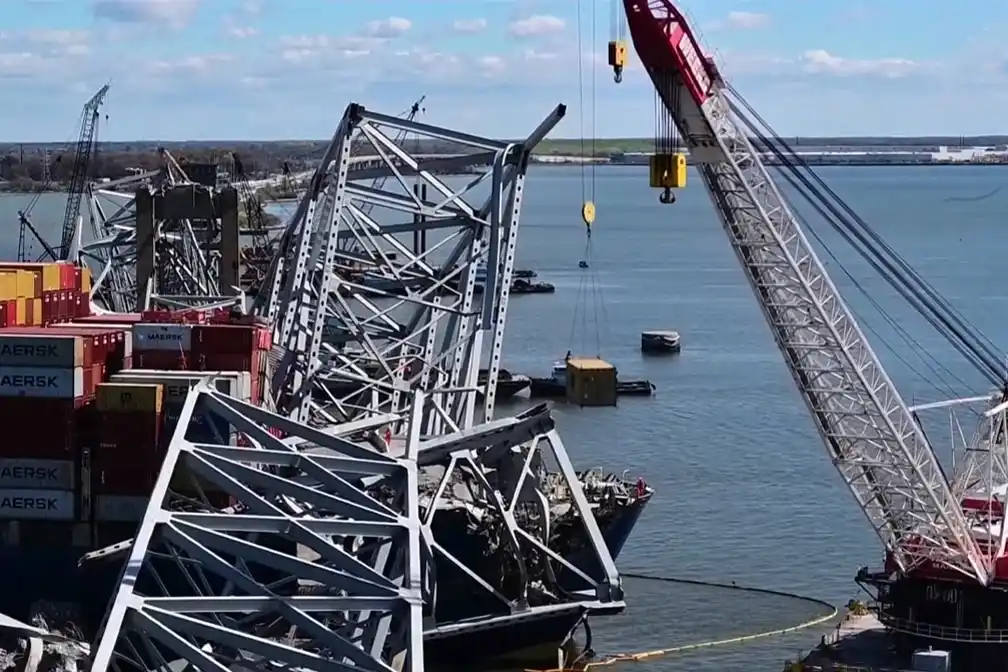
That bridge collapsed on March 26, 2024, after the cargo ship Dali lost power and hit a support pier. Six construction workers died in the incident. One worker was seriously hurt. A person onboard the ship was also injured.
Outdated Design Left Key Bridge at High Risk
The NTSB found that the Key Bridge was almost 30 times above the acceptable risk level for critical bridges. That standard comes from the American Association of State Highway and Transportation Officials (AASHTO). Their guidelines are now used to assess risk of collapse from vessel strikes.
The Key Bridge was built in 1977. It was not designed using the updated AASHTO standards from 1991 or 2009. These newer guidelines help identify bridges that might fail if hit by large ships.
According to the NTSB, “Had the Maryland Transportation Authority (MDTA) conducted a vulnerability assessment of the Francis Scott Key Bridge using the American Association of State Highway and Transportation Officials’ Method II vulnerability assessment calculation, the MDTA would have had information to proactively identify strategies to reduce the risk of a collapse and loss of lives associated with a vessel collision with the bridge.”
Bridge Was Protected—But Not Enough for Modern Ships
The Key Bridge did have protective systems. It included four large dolphin structures and crushable concrete and timber fenders. These features were meant to absorb or deflect the impact of a ship. However, they were built to meet older standards.
When the Dali hit the bridge, none of the dolphin structures were contacted. The ship struck the pier directly. The bridge collapsed shortly after.
Larger ships and more traffic now pass through this waterway. The Dali was almost 1,000 feet long and weighed far more than ships from the 1970s. That added risk was not considered in the bridge’s original design.
NTSB Finds 68 Bridges Without Modern Risk Checks
In its report, the NTSB said it found 101 bridges built before 1996 that were located over navigable waterways. These bridges are often crossed by large ocean-going ships. The agency used filters to narrow the list to 72 bridges that meet certain risk criteria. Of those, 4 have recently been checked. The other 68 have not had recent risk assessments based on today’s vessel traffic.
The NTSB emphasized that these bridges are not necessarily unsafe. However, without proper checks, their risk level remains unknown.
How Bridge Risk Is Measured
AASHTO’s Method II is the current standard for measuring bridge collapse risk from vessel collisions. It uses a formula that calculates something called Annual Frequency of Collapse (AF). This number tells how likely a bridge is to collapse in a given year due to a ship strike.
For bridges considered “critical or essential,” the acceptable AF is 0.0001. The NTSB found that the Key Bridge had an AF of 0.002921—nearly 30 times higher than the limit. That level of risk should have triggered action to strengthen or protect the bridge.
NTSB Calls for Action from Federal Agencies and Bridge Owners
The NTSB is urging the Federal Highway Administration (FHWA), the U.S. Coast Guard, and the U.S. Army Corps of Engineers to create a joint task force. This team would help bridge owners understand their risks. It would also help them make plans to reduce the chance of a collapse.
Bridge owners are being asked to calculate the AF for each of the 68 bridges listed in the NTSB report. If a bridge’s risk level is too high, the owner should then create a plan to fix the problem. That plan should include both short-term and long-term safety steps. The federal team would provide support for those efforts.
NTSB: Bridges Across the U.S. Could Be Affected
The list of 68 bridges includes major structures in California, New York, Texas, Florida, and several other states. Some of these bridges, like the Golden Gate Bridge and the Verrazano-Narrows Bridge, are vital to daily transportation and freight movement.
According to the NTSB, “The 30 owners of 68 bridges over navigable waterways frequented by ocean-going vessels are likely unaware of their bridges’ risk of catastrophic collapse from a vessel collision and the potential need to implement countermeasures to reduce the bridges’ vulnerability.”
The report shows that large ship traffic has grown over the years. That means older bridges may now face greater risks than they did when they were built.
NTSB Aims to Prevent Future Tragedies
This is not the first time a bridge has collapsed due to a vessel strike. The NTSB referenced the 1980 Sunshine Skyway Bridge disaster in Florida as a previous warning. After that incident, AASHTO created its first vessel strike guidelines in 1991.
Still, many older bridges have never been evaluated under these guidelines. Without updated assessments, some may be at greater risk than anyone realizes.
By pushing for these checks now, the NTSB hopes to prevent another tragedy like the Key Bridge collapse. Its message is clear: if the risk is unknown, it cannot be managed.
RELATED: Non-Domiciled CDL Holders Targeted in New Ohio Review, Non-Domiciled CDL Rule: New Jersey Questions Its Impact & Non-Domiciled CDL Rule Upheld for Now After Court Decision