Vincent ShakirApril 17, 20253 Mins read1.5k
Automated Truck Platoons Begin Operating on I-70 in Ohio and Indiana
Testing Truck Automation in the Midwest
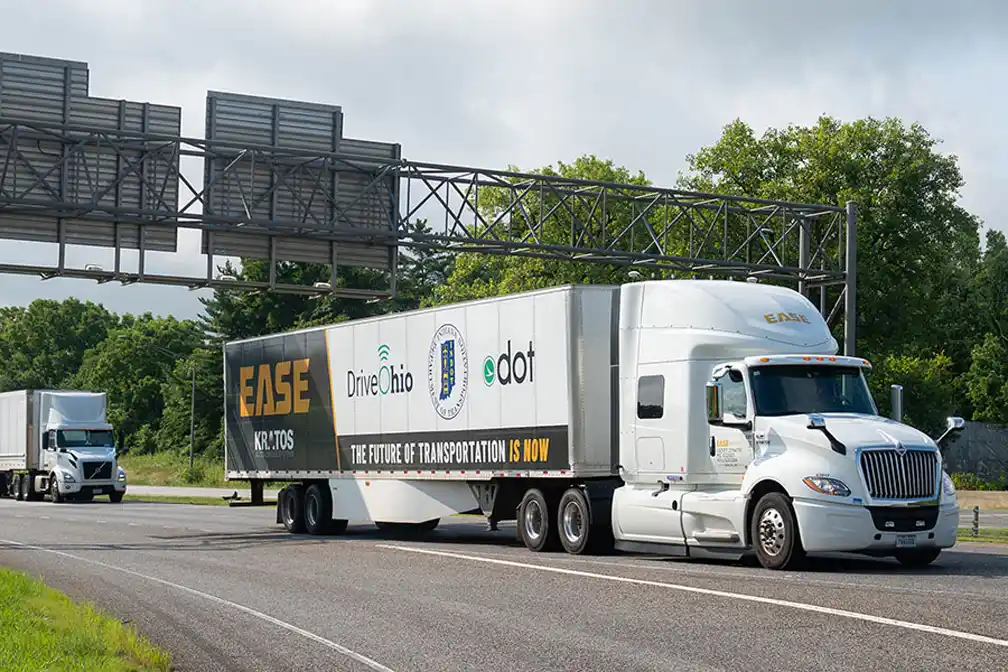
Two partially automated truck platoons are now operating on Interstate 70 between Columbus, Ohio, and Indianapolis, Indiana. Each automated truck is part of a new project testing platooning technology. The effort is led by the Ohio Department of Transportation’s DriveOhio program and the Indiana Department of Transportation.
The trucks are operated by EASE Logistics. They are equipped with technology from Kratos Defense. This system electronically connects the two trucks. The lead driver controls the speed and direction of both vehicles. The second truck follows closely and can automatically steer, accelerate, and brake. However, professional drivers are in both cabs and can take over at any time.
Most automated vehicle testing has taken place in areas with mild weather. This project aims to study how the technology works in the Midwest, where road conditions are often more difficult.
Safety as a Central Goal
Ohio transportation officials say safety is the main reason for launching this program.
“Everything we do at ODOT is driven by safety. We’re committed to reducing deaths on our roadways and vehicle automation technologies can be part of the solution,” said ODOT Director Pam Boratyn. “Many vehicles on the road today have some degree of automated driving systems including adaptive cruise control, lane keep assist, and automatic braking. All of these features are designed to improve safety and reduce driver stress.”
INDOT officials also emphasized the safety angle.
“Harnessing truck automation technology is one of many innovative safety efforts underway at INDOT,” said INDOT Commissioner Lyndsday Quist. “In partnership with Ohio, our goal is to create a safer, lower-stress environment for all drivers.”
The trucks are equipped with object-detection sensors and cameras. These tools help the follower truck adjust speed or come to a stop if a vehicle or object moves between the two trucks. When in platooning mode, a purple light appears on the lead truck. This helps law enforcement and nearby drivers know the trucks are digitally connected and operating closely together.
Technology with Military Roots
Kratos Defense originally developed the platooning system for military use. The company says it has since adapted the system for industries like logistics, agriculture, energy, and mining.
“At Kratos, we have adapted advanced automated truck platooning technology — originally developed for the U.S. military — to address critical challenges facing commercial logistics, agriculture, energy, and mining sectors, all vital to national security,” said Maynard Factor, VP of Business Development at Kratos Defense. “This project offers a real-world opportunity to demonstrate how proven automated driving systems can increase safety, strengthen supply chain resilience, and ensure economic vitality. Operating along the I-70 corridor between Ohio and Indiana enables us to showcase performance in complex, all-weather conditions essential to Midwest freight operations and accelerates readiness for broad adoption. This marks a significant step forward in bringing scalable, next-generation automation to the industries that keep the nation moving.”
Automated Truck Training and Expansion Plans
Before the launch, drivers completed 260 hours of training. EASE Logistics used a step-by-step strategy to prepare for the deployment.
“At EASE, we’re committed to driving innovation in logistics with safety at the core of everything we do,” said Peter Coratola Jr., Founder & CEO at EASE. “Our work on the I-70 project is a clear example of that commitment—we implemented a Crawl/Walk/Run pre-deployment strategy and required our drivers to complete 260 hours of intensive training to ensure they were fully prepared. We’re focused on creating meaningful change in the industry, guided by a clear vision and a deep responsibility to lead. Through projects like this, we’re not only advancing innovation—we’re helping establish EASE and our region as national leaders in transportation.”
Officials say the technology could reduce crashes caused by driver error. It may also help improve freight efficiency and support supply chain operations in the region.
“This technology offers a complete safety system with redundancies that could make roadways safer. It is necessary that we continue to explore improving roadway safety,” said Ohio State Highway Patrol Captain Chris Kinn. “Unlike human drivers, automated vehicles do not drive impaired, text while driving, fall asleep at the wheel, or recklessly speed. The goal of this technology is to take the human error out of the safety equation.”
The total cost of the project is $8.8 million. Part of the funding comes from a U.S. Department of Transportation grant. Ohio and Indiana plan to expand testing in the future. A Request for Proposals will be released later this year for more automated truck deployments across both states.
RELATED: 10 Great Truck Stops Drivers Will Want to Visit, Best Gadgets for Truckers’ Health: Reliable & Expert Advice, Bill SB500 Seeks Better Restroom Access for Truck Drivers