dayileyvasSeptember 4, 20264 Mins read329
Truck Parking Alerts Launch Along Tennessee I-40
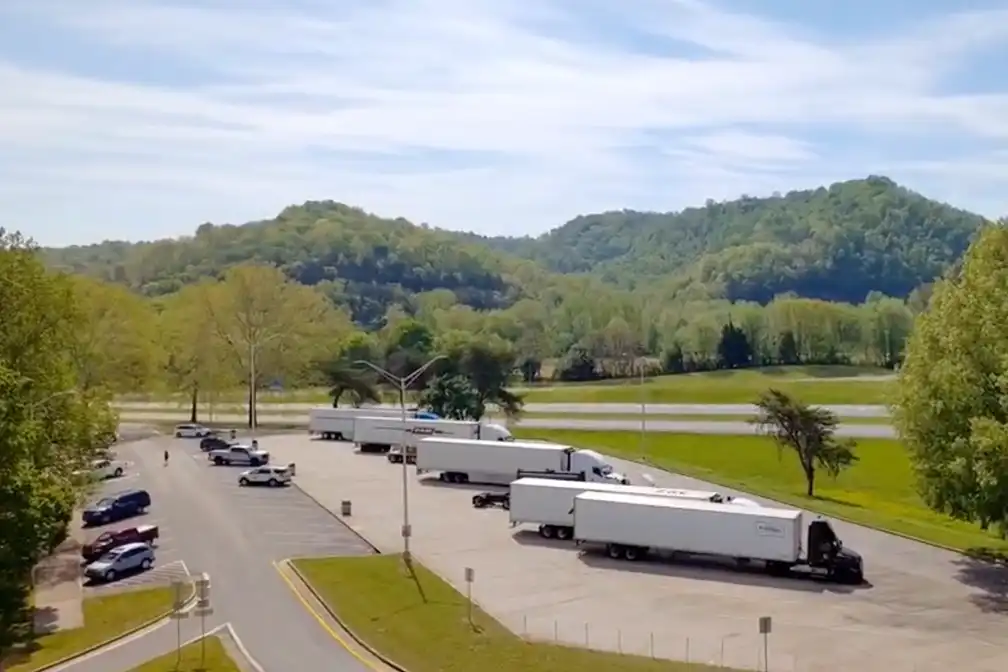
Truck drivers traveling through Tennessee can now receive real-time parking information at an Interstate 40 welcome center. The new system is intended to help drivers determine whether legal parking is available before reaching the facility.
The Tennessee Department of Transportation announced that its Truck Parking Availability System is operational at the I-40 Welcome Center in Smith County. The pilot uses several technologies to monitor spaces and report parking availability.
According to the official TDOT announcement, information can appear on roadside signs and through alerts delivered to in-cab ELD.
The project will be evaluated over the coming months. TDOT will use the results to decide which technology works best and whether similar systems should be installed at other truck parking facilities across Tennessee.
Truck Parking System Begins Operating on I-40
TDOT installed the pilot at the I-40 Welcome Center in Smith County, east of Nashville. The facility serves traffic moving in both directions along the interstate.
The parking system has been integrated into TDOT’s SmartWay network. SmartWay provides information about traffic conditions, construction, incidents and other roadway conditions across Tennessee.
The new system adds truck parking availability to that network. Its purpose is to provide information before a driver enters the welcome center and begins searching for an open space.
The technology is now fully operational, according to TDOT. However, the agency is still testing its accuracy and comparing the different detection methods used at the location.
Four Technologies Monitor Available Spaces
TDOT is testing four types of monitoring equipment at the welcome center. Each technology collects information differently.
The pilot includes:
- Magnetometers that count trucks entering and leaving the eastbound parking lot.
- Radar and camera sensors that track trucks entering and leaving the eastbound lot.
- Radar and camera sensors that identify available spaces in the westbound lot.
- LiDAR equipment that detects open spaces in the westbound lot.
- Closed-circuit television cameras that also monitor westbound parking availability.
LiDAR uses light pulses to measure distances and identify objects. The system can use those measurements to determine whether a parking space is occupied.
Testing several methods at one location will allow TDOT to compare their performance. Weather, lighting, traffic movement and parking patterns could affect how accurately each system detects available spaces.
TDOT said the evaluation will help establish recommended technology and operating standards for possible statewide use.
Drivers Can Receive Truck Parking Alerts
Parking information from the system will be distributed in two main ways.
Roadside signs can show drivers whether parking is available as they approach the welcome center. TDOT also said availability alerts can be sent through in-cab ELDs.
The ELD feature may allow drivers to receive the information without searching for parking updates on a separate device. The availability of those alerts could depend on the ELD platform and services used by a carrier.
The department did not identify every ELD provider participating in the pilot. It also did not say how frequently availability information will be refreshed.
Drivers at the welcome center can provide feedback by scanning QR codes displayed on signs in the truck parking area. TDOT plans to use that feedback as it evaluates the system.
Cameras Will Not Be Used for Enforcement
Some portions of the pilot use cameras to determine whether parking spaces are occupied.
TDOT said cameras installed for the project will operate similarly to cameras already used through its SmartWay system. Images collected for parking monitoring will not be recorded or used for enforcement, according to the department.
The cameras are intended to detect available spaces rather than identify drivers, vehicles or license plates.
That distinction is important because truck parking systems can raise questions about how camera footage and vehicle information are handled. TDOT’s announcement states that enforcement is not part of this pilot.
The agency did not provide additional information about data retention for the system’s other sensors.
Truck Parking Information Could Help With HOS Planning
Finding legal parking can become more difficult near the end of a driver’s available hours. A parking area may appear on a map but be full when the truck arrives.
When that happens, a driver must decide whether to continue looking for another location or stop somewhere that may not be designed for commercial vehicles. Parking on highway shoulders and entrance or exit ramps can create safety risks and may violate state or local restrictions.
Real-time information cannot create additional spaces, but it can help drivers make earlier parking decisions. A driver who learns that the welcome center is full may be able to stop at another location before reaching the end of available driving time.
TDOT said advanced notice could help drivers determine whether they can continue toward the welcome center or should find parking sooner.
The system does not change federal hours-of-service requirements. It also does not guarantee that a space shown as available will remain open until a truck reaches the facility.
Federal Grant Supported the Tennessee Pilot
The project was funded through the U.S. Department of Transportation’s Strengthening Mobility and Revolutionizing Transportation grant program, commonly called the SMART Grants Program.
TDOT developed the pilot with Stantec, an engineering and consulting company. The state agency presented the project as an effort to evaluate technology that could support safer and more dependable parking decisions.
Although the system is operating, it remains a pilot. TDOT has not announced a schedule for expanding the technology to every state-operated truck parking area.
Any broader installation would likely depend on the pilot’s performance, available funding and the cost of maintaining the equipment and information network.
What Comes Next for Tennessee Truck Parking
TDOT will monitor the different technologies over the next several months. The agency will examine their accuracy and use driver feedback to help determine which approach should be recommended.
If the pilot performs as intended, Tennessee could use the results to develop common standards for other truck parking locations. The announcement does not guarantee a statewide expansion.
For now, the immediate change is limited to the I-40 Welcome Center in Smith County. Drivers passing through the area may see parking information on roadway signs or receive compatible in-cab alerts.
The project gives Tennessee a way to test whether real-time information can make existing truck parking easier to locate and use. Its long-term value will depend on the reliability of the alerts and whether the system eventually reaches additional freight corridors.