Vincent ShakirMay 7, 20265 Mins read722
Driverless Trucks Move From Pilot to Freight Hauls
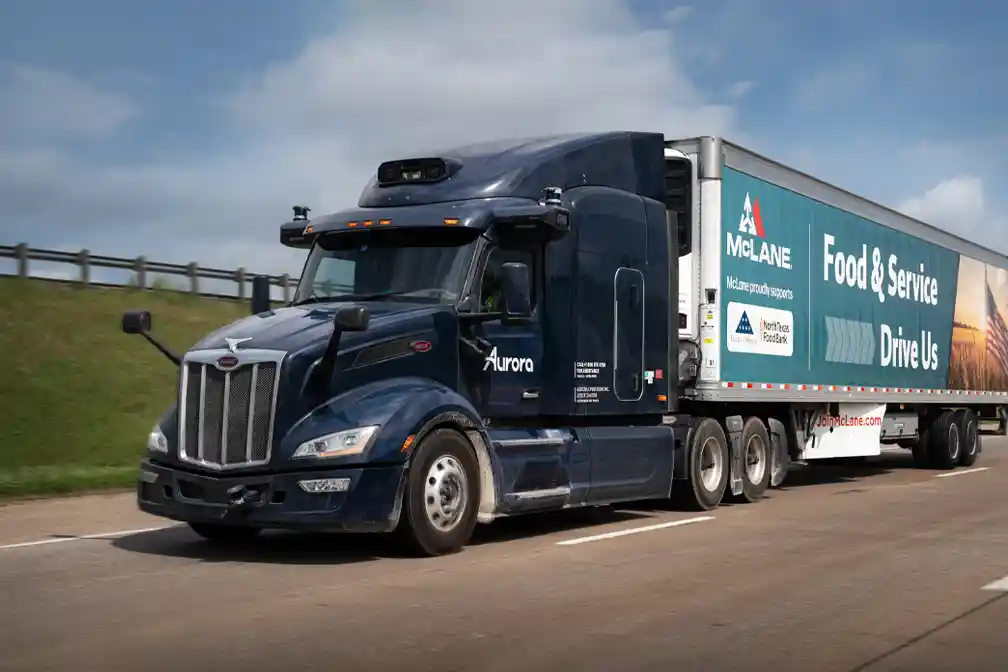
Aurora Innovation and McLane Company have announced a new agreement to begin driverless commercial truck hauls in Texas using the Aurora Driver. The system is an SAE Level 4 (“High Automation”) self-driving system built first for long-haul trucking.
The move follows a supervised autonomous trucking pilot that began in 2023. During that pilot, Aurora said its system logged more than 280,000 autonomous miles in Texas and delivered 1,400 loads for McLane.
McLane, a Berkshire Hathaway subsidiary and one of the largest distributors in the United States, serves chain restaurants, convenience stores, and mass merchants. The company has now approved Aurora’s move to driverless operations between Dallas and Houston.
The announcement marks a new step for autonomous trucking in commercial freight. It also gives a clearer look at how major fleets may use driverless trucks in the near term. The focus is not on every part of the trucking job. Instead, this use is on repeatable long-haul lanes between distribution points.
Driverless Trucks Will Handle the Middle Mile
The companies described the operation as a hybrid model. Under that setup, the Aurora Driver will handle the long-haul “middle mile,” while McLane drivers will continue handling local deliveries to customer locations.
That distinction matters for commercial truck drivers.
The middle mile usually refers to freight that moves between hubs, terminals, warehouses, or distribution centers. In this case, the driverless operation will run between Dallas and Houston. These lanes can be more predictable than final-mile delivery routes because they often use the same roads, schedules, and freight patterns.
The last mile is different. It often requires more hands-on work. McLane drivers still serve restaurants, convenience stores, and other customer locations. That work can include local traffic, tight delivery areas, customer service needs, delivery windows, and site-specific challenges.
McLane said its drivers will remain focused on the critical last mile. The company also said those drivers will continue serving as the face of the company to customers.
McLane Pilot Logged 1,400 Loads
Aurora and McLane began working together on supervised autonomous freight operations in 2023. Since then, Aurora said its system has delivered 1,400 McLane loads and logged more than 280,000 autonomous miles in Texas.
The companies also said the pilot reached 100% on-time performance. Based on that record, McLane approved the move to driverless hauls between Dallas and Houston.
During the pilot, Aurora said the operation grew to two round trips per day between Dallas and Houston, seven days a week. The freight included supplies and perishable food used by McLane’s restaurant customers.
That schedule is important because food and restaurant supply chains often depend on steady delivery times. Perishable freight can also place added pressure on carriers to keep trucks moving and meet tight schedules.
Aurora said autonomous trucks moving refrigerated freight around the clock could provide more steady capacity. The company also said the trucks could help freight networks adjust to changing demand.
What Driverless Trucks Mean for Truck Drivers
For truck drivers, the key point is not that every driving job is being automated. The announcement shows that these driverless trucks are being aimed first at certain types of freight. In this case, that means repeatable, long-haul middle-mile routes.
That could matter most to drivers who run dedicated regional lanes, especially in areas where freight moves between major distribution points. Dallas to Houston is a high-volume Texas freight corridor. The route gives Aurora and McLane a real-world lane for driverless commercial operations.
For local delivery drivers, the near-term impact appears different. McLane said its drivers will continue handling the last mile. That suggests the company still sees human drivers as important for customer-facing delivery work.
This could also be a sign of how large fleets may divide work in the future. Driverless trucks may be used for highway freight between facilities. Human drivers may continue to handle local delivery, customer contact, and more complex routes.
For owner-operators and company drivers, the broader question is whether more fleets will look at this model for other dedicated freight lanes. Aurora said it plans to expand to new routes between McLane distribution centers across the U.S. Sun Belt by the end of the year. The company also said it plans to serve more McLane business in the future.
Why Fleets Are Watching Driverless Trucks
McLane is not a small test customer. Founded in 1894, the company has more than 80 distribution centers across the country. It also has more than 25,000 employees and delivers to nearly every zip code in the United States.
That scale gives the announcement added weight in the trucking industry. When a large distributor approves driverless operations after a supervised pilot, other fleets may watch closely to see whether the model works.
The release points to several reasons fleets may be interested in autonomous trucking. Those include efficiency, reliable capacity, steady transit schedules, and help with labor constraints.
Those points matter in trucking because fleets often deal with hours-of-service rules, delivery windows, equipment use, and freight demand that changes throughout the week. A truck that can run a middle-mile lane on a steady schedule could be appealing for some operations.
At the same time, the release does not say that McLane is removing drivers from its last-mile delivery work. Instead, it presents the system as a way to support the supply chain while keeping McLane drivers focused on customer deliveries.
Safety and Compliance Questions Remain
While the announcement provides several performance numbers from the pilot, it does not answer every trucking question that drivers, fleets, and safety departments may have.
The release says Aurora’s system safely delivered goods for McLane and reached 100% on-time performance during the pilot. It also says McLane was impressed with Aurora’s safety performance and operational work.
However, the announcement does not explain how all roadside or compliance issues would be handled during driverless operations. It does not describe what happens if a truck has a tire issue, mechanical problem, refrigerated load concern, inspection question, or roadside emergency.
It also does not provide details about how law enforcement, roadside inspectors, or safety personnel would interact with a driverless truck during a stop or incident.
Those questions are important because commercial trucks do more than move from point A to point B. Truck drivers often handle inspections, paperwork, load issues, dispatch updates, equipment problems, and customer needs. Driverless trucks may reduce some driver tasks on certain lanes, but they also create new operational questions for carriers and regulators.
Driverless Trucks Could Expand Across the Sun Belt
Aurora said it plans to expand driverless operations to new routes between McLane distribution centers across the U.S. Sun Belt by the end of the year.
That expansion plan may be one of the most important details in the announcement. The Dallas-Houston route appears to be the starting point, not the full scope of the partnership.
If the model grows, it could give McLane more driverless middle-mile capacity across parts of the country where long-haul freight moves between distribution centers. It may also give Aurora more real-world freight operations in food distribution, refrigerated trucking, and private-fleet logistics.
For truck drivers, that makes this announcement worth watching. It shows how driverless trucks may enter the industry one lane and one freight type at a time.
A New Split Between Driverless and Human Work
The Aurora and McLane agreement does not signal an end to human trucking jobs. Instead, it points to a more specific shift. In this case, driverless trucks are being used for the middle mile, while human drivers remain in the last mile.
That split may become a major part of the autonomous trucking debate. Long-haul highway freight may be easier to automate than customer-facing delivery work. Local delivery routes often require judgment, flexibility, communication, and hands-on service that a self-driving system does not replace in this announcement.
For now, McLane’s Texas operation gives the trucking industry another example of how driverless trucks may enter commercial freight. The technology is moving beyond supervised pilots on select routes. But the role of human drivers remains central in the parts of the job that require service, local knowledge, and direct customer contact.