dayileyvasApril 24, 20263 Mins read1.4k
Georgia Advances Truck-Only Lanes Project on I-75
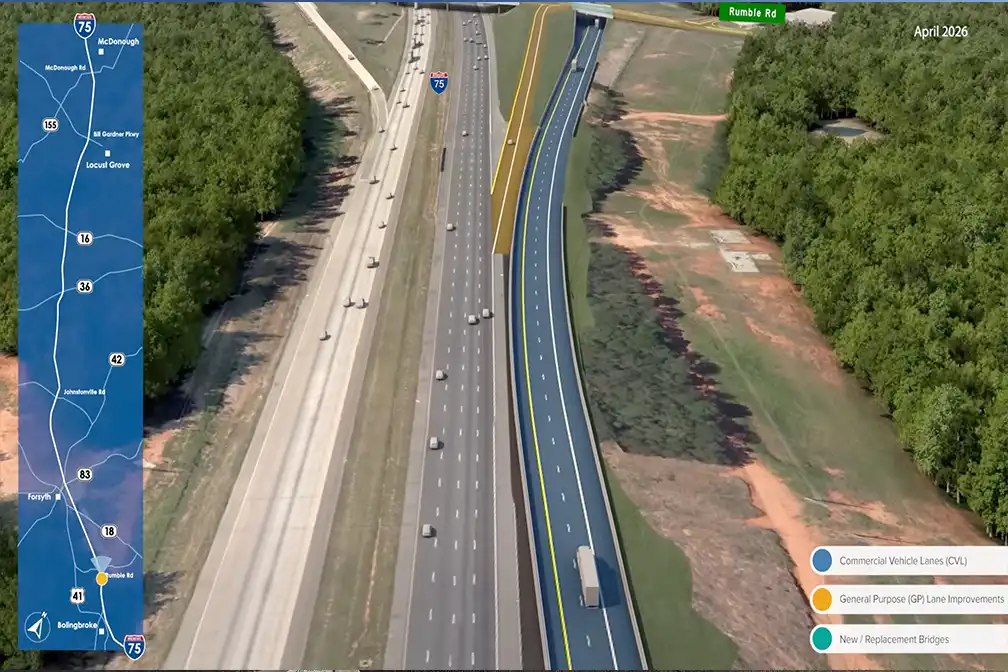
Georgia officials are moving forward with a plan to build truck-only lanes along a heavily traveled section of I-75 in Middle Georgia. The project, led by the Georgia Department of Transportation (GDOT), is designed to separate commercial trucks from passenger vehicles along a 41-mile corridor. The proposal focuses on northbound traffic between the Macon area and metro Atlanta. State officials say the project is intended to address congestion and improve traffic flow along one of the region’s busiest freight routes. The addition of truck lanes is being considered as one approach to manage growing freight demand on I-75.
Truck-Only Lanes Project Details and Coverage Area
The plan calls for the construction of two barrier-separated lanes starting near the I-75/I-475 interchange in Monroe County and extending north to the State Route 20 interchange near McDonough.
The corridor runs through several counties, including Monroe, Butts, Lamar, Spalding, and Henry. According to GDOT, trucks with more than six wheels would be required to use the truck-only lanes unless they are exiting locally.
The project is part of a larger state effort to update freight infrastructure and manage increasing traffic volumes on major highways. Officials say these lanes are intended to improve how freight traffic moves through the region.
Development Phase and Timeline
The project is currently in the development stage. GDOT is reviewing early design plans and completing environmental studies required for federal approval.
A public comment period is also underway as part of the planning process, with feedback open through May 28, 2026.
Construction is expected to begin in late 2026, although timelines may change as the truck-only lanes project moves through final approvals.
Local Impacts Across Middle Georgia
In Monroe County, the project will start just south of the I-475 interchange. Plans include new ramps that will guide trucks into the dedicated lanes. Drivers in the area may see bridge replacements and traffic pattern changes along roads such as Pate Road, Rumble Road, and Juliette Road.
Further north, work in Butts and Lamar counties will involve additional truck entry and exit points near State Routes 36 and 16. Bridge upgrades are also planned at High Falls Road and Cowan Road.
Reconstructed interchanges are expected at key points along the corridor, including State Routes 18 and 83.
Additional Road Projects in the Region
Alongside the I-75 project, GDOT has announced other road improvements tied to the same corridor.
A $5.9 million resurfacing project will cover more than 17 miles of State Route 42 in Monroe and Butts counties. In Washington County, a separate $5.09 million contract will resurface a 15-mile stretch of State Route 272, with completion expected by early 2027.
State data shows GDOT awarded about $96.5 million in projects in March, contributing to more than $2 billion in total project awards for the fiscal year.
Reported Goals of Truck-Only Lanes for Traffic and Safety
State officials say the lanes are expected to reduce delays for commercial vehicles and improve traffic flow in general-purpose lanes. The separation of truck and passenger traffic is also described as a way to address safety concerns along the corridor.
Officials also state that shifting heavy truck traffic out of standard lanes may reduce roadway wear and long-term maintenance needs. These expected outcomes are part of the reasoning behind expanding truck-only lanes on major freight routes.
What Truck Drivers Should Expect
If the project moves forward as planned, truck drivers traveling northbound on this section of I-75 will be required to use the truck lanes unless they are exiting the highway.
The dedicated lanes may offer more consistent travel times, especially during periods of heavy congestion. However, drivers should also expect construction-related disruptions, including lane shifts and temporary closures, once work begins.
More details are expected as GDOT completes its review process and finalizes design plans for the truck-only lanes project.
RELATED: ATA Truck Tonnage Index Reaches New High in March, Enfield Rest Area Closed Now on I-94 for Upgrades, FMCSA Reviews CDL Exemption Request for New Truck Drivers