dayileyvasNovember 2, 20264 Mins read28
Washington Chain Rules Now in Effect for Truck Drivers
Washington’s seasonal chain rules are now in effect for commercial trucks on designated highways, including major freight routes across the Cascade Mountains.
From November 1 through April 1, vehicles and combinations over 10,000 pounds gross vehicle weight rating must carry enough tire chains to meet state requirements on the listed routes. The seasonal obligation applies even when roads are clear and no chain-up advisory is posted.
This is an existing annual requirement, not a newly adopted law. For interstate truck drivers entering Washington, the immediate issue is whether the truck has the correct equipment before reaching a covered highway.
WSP Plans Chain Enforcement on Snoqualmie Pass
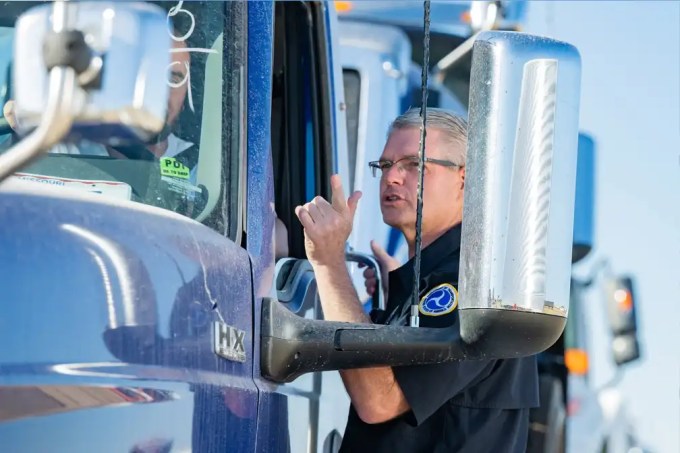
Washington State Patrol announced November 2 that troopers will conduct a two-day commercial vehicle chain enforcement emphasis on Snoqualmie Pass November 3–4.
The operation will focus on educating drivers and checking whether commercial vehicles carry the appropriate amount of snow traction equipment during the winter season.
“Our main goal is to educate and gain compliance with CMV drivers to carry chains from November 1st to April 1st,” Trooper Jeremy Weber said.
WSP plans to post results on social media after the operation. The emphasis concerns carrying required equipment; whether chains must be installed depends on posted traction controls and conditions.
Chain Rules Separate Carrying From Installation
Washington’s chain rules distinguish between having chains aboard and mounting them on the tires.
The seasonal carrying requirement means qualifying trucks must have the necessary equipment available while operating on designated routes. Installation depends on posted traction controls and the vehicle’s configuration.
WSDOT’s winter driving guide explains that a “Traction Tires Required” advisory requires chains on vehicles rated over 10,000 pounds. Passenger-vehicle exceptions should not be assumed to apply to commercial trucks.
During more severe conditions, the state can require chains on every vehicle, including four-wheel-drive and all-wheel-drive vehicles. Studded tires do not satisfy chain requirements.
I-90 and I-82 Are Among the Covered Routes
The seasonal requirement includes two important interstate segments:
- I-90: Between North Bend at milepost 32 and Ellensburg at milepost 101.
- I-82: Between Ellensburg’s Exit 3 and Selah’s Exit 26.
Other covered corridors include sections of State Routes 2, 12, 14, 20, 97, 155, 410, 542 and 970.
These routes include travel over Snoqualmie, Stevens, White, Blewett and other mountain passes. The requirement applies to specified highway segments rather than every road in Washington.
The State Patrol’s commercial-vehicle chaining brochure provides a route list and equipment diagrams. That distinction matters for trip planning because crossing into Washington does not, by itself, mean every local road falls under the seasonal carrying rule.
Required Chain Placement Depends on the Truck
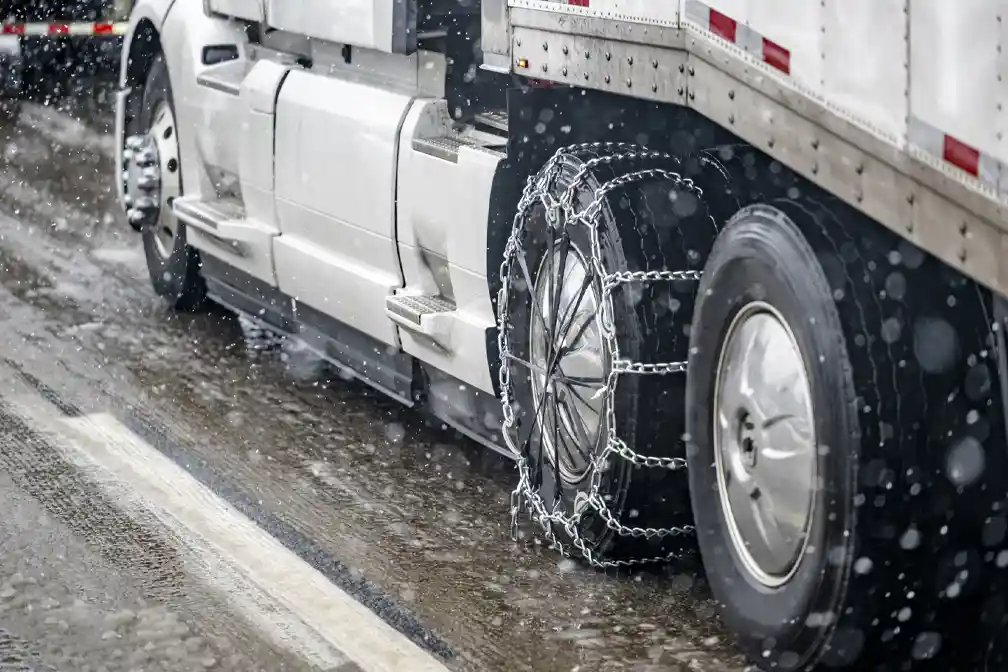
Washington’s chain rules vary by axle arrangement. A tractor-trailer combination may need chains on both drive tires and trailer tires when controls are posted.
For a common five-axle tractor with tandem drive axles and a tandem-axle semitrailer, the rule requires chains on at least four drive tires, along with the required trailer tire. Other combinations, including trucks with six or more axles, have different placement requirements.
The rule also requires vehicles over 10,000 pounds GVWR to carry at least two extra chains. Those extras are intended for worsening conditions or chains that break or become unusable. They are in addition to the equipment needed for the vehicle’s required chain configuration.
WSDOT links to diagrams showing the required placement for different combinations. The correct equipment cannot be determined solely by whether a vehicle is described as a semi-truck or commercial vehicle.
Approved Equipment Matters
WSDOT specifies construction requirements for conventional chains, including hardened-metal cross chains and side chains. Plastic chains are not allowed under its heavy-vehicle guidance.
Washington State Patrol may approve alternative traction devices, but approval depends on the device and its permitted application. A product suitable for a passenger vehicle is not automatically approved for a commercial combination.
State Patrol guidance directs operators to its approved-device information and commercial-vehicle chaining diagrams. It also makes clear that studded tires are not a substitute for chains and are not allowed on vehicles over 10,000 pounds.
Violating Chain Rules Can Interrupt a Trip
WSDOT says drivers who fail to install chains when required risk a $500 fine.
The operational consequences can extend beyond a citation. In its winter-preparation announcement, the department warned that a single spinout can close a mountain pass. Crashes involving spilled fuel or specialized towing equipment can take longer to clear.
For commercial drivers, those closures can disrupt delivery appointments, consume available working time and affect subsequent loads. Proper equipment does not eliminate winter delays, but arriving without it can create an additional barrier to completing a trip.
Local Deliveries and Oversize Loads Have Separate Limits
A limited exception applies to vehicles making local deliveries documented on bills of lading when they remain outside chain-required areas and do not cross a mountain pass.
Oversize movements require separate attention. WSDOT prohibits permitted movements over mountain passes when specified traction or chain-control signs are displayed. Carrying chains does not override those restrictions.
The department also maintains commercial-vehicle resources covering route restrictions, bridge clearances and permit-related travel limits. Those requirements remain separate from the seasonal obligation to carry chains.
Current Conditions Determine When Chains Go On
The November 1 deadline establishes the seasonal carrying requirement. It does not mean chains must remain installed throughout the winter.
Posted controls and current conditions determine when installation is necessary. WSDOT provides mountain-pass reports, traffic cameras, a real-time travel map and mobile alerts to track changing restrictions.
For the 2026–2027 winter season, the key distinction is straightforward: qualifying trucks must already have the required chains aboard on designated routes, while installation requirements can change as weather and road conditions worsen.