dayileyvasOctober 9, 20264 Mins read329
FMCSA Grants New 5-Year Exemption for Autonomous Trucks
The Federal Motor Carrier Safety Administration (FMCSA) has approved a five-year exemption allowing certain autonomous trucks to use flashing warning beacons instead of traditional roadside warning triangles. The decision was published in the Federal Register on October 9, 2026. It applies to Aurora Operations Inc. and other qualifying motor carriers operating Level 4 automated commercial vehicles.
The exemption took effect October 7, 2026, and remains valid through October 7, 2031, unless it is revoked earlier.
FMCSA determined that the alternative warning system would likely provide safety equivalent to or greater than existing requirements. However, several trucking organizations and individual drivers raised concerns about visibility and roadside safety.
Autonomous Trucks Can Replace Warning Triangles With Beacons
Under existing federal regulations, commercial truck drivers must place warning devices around a stopped vehicle in certain roadside situations. These devices generally include reflective triangles or other approved warning equipment. Drivers must place them as soon as possible, but within 10 minutes of stopping.
The requirements are intended to alert approaching motorists to a stopped commercial vehicle. However, autonomous trucks operating without a human driver cannot physically place warning triangles on the roadway.
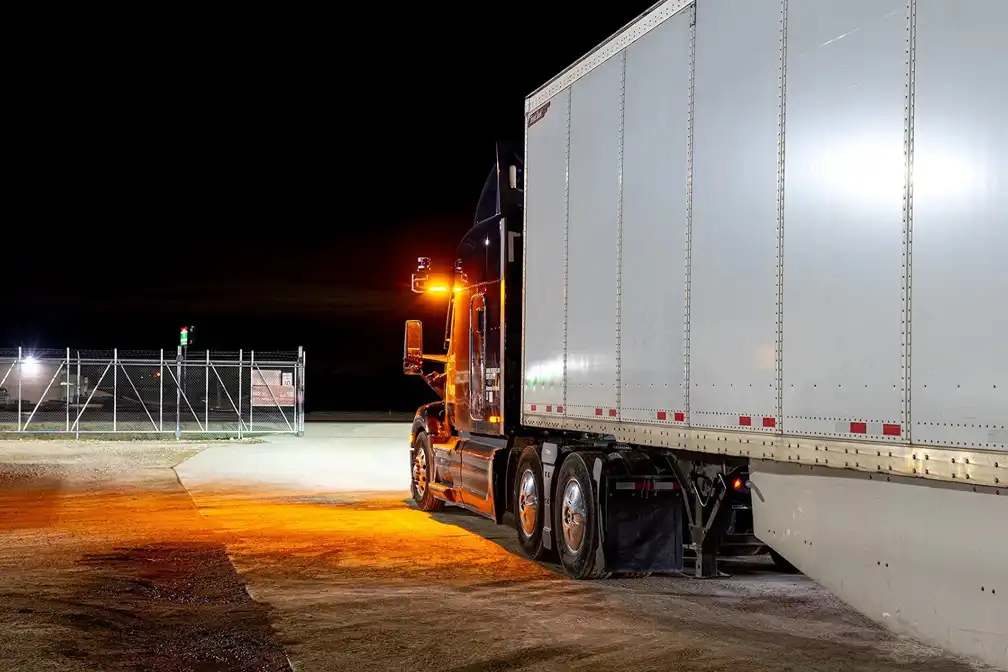
Aurora requested permission to use flashing amber warning beacons mounted on the truck’s cab instead.
The approved exemption covers three federal regulations:
49 CFR 392.22(b): Requirements for placing warning devices around stopped commercial vehicles.
49 CFR 393.25(e): Requirements for steady-burning exterior lamps.
49 CFR 393.95(f): Requirements concerning the types and number of warning devices.
The exemption applies only to qualifying Level 4 autonomous commercial vehicles. It does not eliminate warning triangle requirements for conventional trucks.
FMCSA Sets Safety Conditions for Autonomous Trucks
FMCSA established several conditions that carriers must follow when operating under the exemption. The alternative warning system must use flashing amber lights mounted on the cab. The lights must face forward and backward to alert approaching traffic. The agency also established technical requirements for their location, brightness, and power supply.
Among the requirements:
- Warning beacons must activate within five minutes of a qualifying stop.
- The lights must meet SAE J595 Class 1 brightness standards.
- The system must have redundant power sources to reduce the risk of electrical failure.
- Vehicles must operate within their validated operating conditions and approved roadway environments.
- The exemption cannot be used for hazardous materials or passenger transportation.
- Longer combination vehicles are limited to doubles with two 28-foot trailers. Triples are excluded.
Other qualifying motor carriers must notify FMCSA before using the exemption.
These restrictions are intended to address safety concerns while allowing autonomous trucking companies to operate without manually placing roadside warning devices.
Trucking Organizations Raise Concerns About Roadside Safety
FMCSA received 402 public comments regarding Aurora’s exemption request.
Several organizations supported the proposal, including the American Trucking Associations (ATA), the Autonomous Vehicle Industry Association, and Volvo Group North America.
Supporters argued that cab-mounted warning beacons could improve visibility and eliminate the need for someone to exit a vehicle near moving traffic.
Some also suggested that similar technology could eventually benefit conventional truck drivers.
However, the proposal faced opposition from several trucking and highway safety organizations.
The Owner-Operator Independent Drivers Association (OOIDA), REAL Women in Trucking, and the Truck Safety Coalition were among those raising concerns.
Opponents questioned whether cab-mounted lights would provide sufficient warning in different road and weather conditions.
Concerns included:
- Curves and hills that could obstruct warning lights.
- Trailers blocking the view of cab-mounted beacons.
- Electrical failures affecting the warning system.
- The absence of warning devices placed at different distances from the stopped truck.
- Limited testing during unexpected roadside emergencies.
OOIDA also questioned whether the studies submitted by Aurora adequately represented the range of conditions commercial vehicles encounter.
These concerns focused on whether flashing lights could consistently provide the same warning as reflective triangles positioned along the roadway.
Aurora Reports More Than 500,000 Miles of Testing
Aurora previously sought an exemption from similar requirements in 2023.
FMCSA denied that request in December 2024, citing concerns about insufficient information and the broad scope of the proposed exemption.
The agency later issued a temporary waiver allowing Aurora to operate with cab-mounted warning beacons under specific conditions.
According to information Aurora submitted to FMCSA, 34 commercial vehicles traveled more than 500,000 miles during a waiver period from October 10, 2025, through January 9, 2026.
The company reported that its warning beacons activated for nearly 10 hours during that period.
Aurora also reported no beacon malfunctions, power failures, or roadway collisions involving stopped vehicles using the warning system.
These figures were supplied by Aurora and summarized in FMCSA’s decision.
Although FMCSA considered the information in its evaluation, the reported results do not establish how the system would perform in every possible roadside emergency.
FMCSA Says Warning Beacons May Provide Comparable Safety
FMCSA also reviewed two studies examining how motorists respond to warning beacons compared with traditional triangles.
One study was prepared by Aurora, while another was conducted by the Virginia Tech Transportation Institute for Waymo.
According to FMCSA, the studies indicated that drivers generally detected and responded to the alternative warning systems at comparable levels.
In six of eight scenarios examined in Aurora’s study, motorists began responding farther from the stopped truck when warning beacons were used.
FMCSA cited these findings as part of its decision to approve the exemption.
However, the agency acknowledged that certain unusual circumstances could affect beacon visibility.
The approval therefore includes restrictions on vehicle operations and requirements for continued safety reporting.
Autonomous Truck Operators Must Report Safety Problems
The exemption does not give autonomous trucking companies unrestricted permission to replace roadside warning devices.
Participating carriers must meet FMCSA’s conditions and provide information about their operations.
The agency requires annual reporting of warning beacon malfunctions, power problems, and other situations where the equipment does not operate as required.
The exemption also includes crash-reporting requirements.
FMCSA may revoke the exemption if the agency determines that its use results in a lower level of safety than required.
These reporting requirements could help the agency evaluate how the technology performs during actual trucking operations.
What the Exemption Means for Truck Drivers
For conventional truck drivers, the immediate impact is limited.
The new exemption does not change existing federal roadside warning device requirements for trucks operated by human drivers.
However, FMCSA acknowledged that cab-mounted warning beacons could offer potential safety benefits beyond autonomous trucking.
The agency noted that placing warning triangles can expose drivers to passing traffic, particularly along busy highways and shoulders.
FMCSA suggested that broader changes to warning device regulations for commercial vehicles may deserve future consideration.
That statement does not establish a new rulemaking or guarantee that the requirements will change.
For now, the decision creates a limited regulatory exemption for qualifying autonomous trucks while maintaining existing requirements for conventional commercial vehicles.
The five-year period will allow FMCSA to collect additional operating information and assess whether the alternative warning systems continue to meet federal safety expectations.