Vincent ShakirOctober 7, 20253 Mins read1.4k

CVSA Releases 2025 International Roadcheck Results
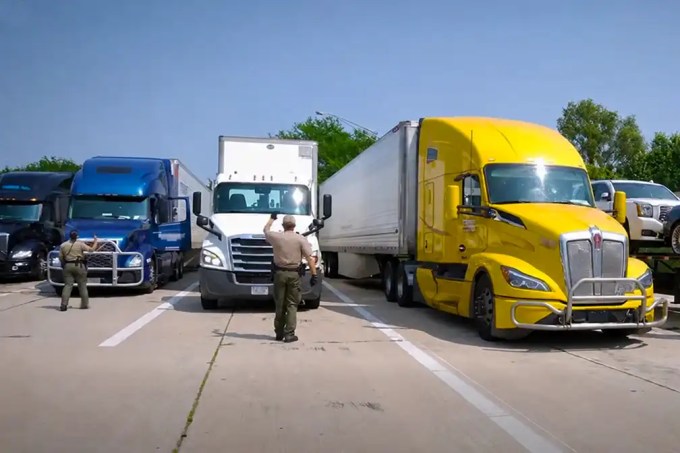
The CVSA has released the results of the 2025 International Roadcheck. The annual event took place from May 13–15 across the United States, Canada, and Mexico. During the three-day inspection period, enforcement teams performed 56,178 inspections on trucks, drivers, and cargo.
According to the CVSA, 81.6% of vehicles and 94.1% of drivers had no out-of-service (OOS) violations. However, inspectors still found 13,553 vehicle, 3,317 driver, and 177 hazardous materials/dangerous goods (HM/DG) violations. A total of 10,148 vehicles and 3,342 drivers were placed out of service.
When a truck driver or vehicle is placed out of service, they cannot continue operating until all problems are fixed.
CVSA Vehicle and Driver Out-of-Service Rates
The vehicle out-of-service rate was 18.1%, while the truck driver out-of-service rate was 5.9%. During inspections, officials also issued 16,521 CVSA decals to vehicles that passed Level I or Level V inspections with no major issues.
The decals are placed on vehicles that meet safety inspection standards. They show that the vehicle is safe and compliant. Mexico does not distribute CVSA decals, so the totals include only the United States and Canada.
CVSA 2025 Focus Areas: Tires and False Logs
Each year, the CVSA International Roadcheck highlights one main focus for vehicles and another for drivers. In 2025, inspectors focused on tire safety and false records of duty status (RODS).
Tires were a major issue again this year. Inspectors found 2,899 tire-related violations, which made up 21.4% of all vehicle out-of-service violations. Tire problems included flat tires, low tread depth, cuts exposing inner layers, poor repairs, or tires not suited for the load or highway use.
Brake problems continued to top the list of vehicle issues. Inspectors found 3,304 brake system violations and 2,257 cases where 20% or more of a vehicle’s brakes were not working. Combined, these accounted for 41.1% of all vehicle violations during the inspection.
On the driver side, false logs were still a serious concern. The CVSA reported 332 violations, or about 10% of all driver out-of-service cases, were due to falsified duty records. False logs hide the real number of hours a driver has worked or driven, increasing the risk of fatigue and unsafe driving.
CVSA Reports Hours-of-Service as Top Driver Violation
Inspectors performed 54,953 Level I, II, and III inspections on drivers during the event. Of those, 3,342 drivers (or 6.1%) were placed out of service. The top driver violation in both the United States and Canada was hours-of-service noncompliance, making up 32.4% of all driver out-of-service cases.
Other common violations included licensing problems, false logs, and operating under the influence of drugs or alcohol.
Mexico’s out-of-service violations were all vehicle-related, so the driver statistics reflect only the U.S. and Canada.
The CVSA reminded drivers that hours-of-service rules are designed to reduce fatigue-related crashes and keep drivers safe on the road.
CVSA Findings on Hazardous Materials and Dangerous Goods
Inspectors also paid close attention to trucks carrying hazardous materials and dangerous goods (HM/DG). They found 177 HM/DG out-of-service violations, with 51 (or 28.8%) related to improper loading.
Loading and securement rules are vital because they prevent cargo from shifting, leaking, or spilling. This is especially important for materials that are flammable, toxic, or pose environmental risks.
The CVSA reports that inspecting HM/DG shipments requires special training. Inspectors must check for leaks, review shipping papers, confirm proper labeling and placarding, and verify that materials are loaded and packaged safely.
Seat Belt Violations
Seat belt use remains an issue among some commercial drivers. During the Roadcheck, 726 seat belt violations were reported.
According to the Federal Motor Carrier Safety Administration (FMCSA), about 14% of commercial vehicle drivers still do not wear seat belts. The National Highway Traffic Safety Administration (NHTSA) notes that seat belts are the most effective way to prevent death or injury in a crash.
Seat belts saved 14,955 lives in one year and could have saved 2,549 more if everyone had worn them.
CVSA Explains the Types of Inspections
The CVSA conducted multiple types of inspections during the 2025 International Roadcheck. The most common was the Level I inspection, which includes a 37-step process to check both the driver’s documents and the vehicle’s condition.
Other inspection types included:
- Level II. This is a walk-around inspection that does not require the inspector to go under the vehicle.
- Level III. These focus on the driver’s documents, logbooks, and Drug and Alcohol Clearinghouse records.
- Level V. A vehicle-only inspection that can be done without the driver present.
Across all inspection levels, officials conducted 56,178 inspections in total. On average, about 13 vehicles per minute were inspected across North America during the three-day event.
Mission for Safer Roads
The CVSA International Roadcheck has been held every year since 1988. Over that time, inspectors have completed more than 1.8 million inspections across North America.
The CVSA says the event gives a clear snapshot of the trucking industry’s safety and compliance levels. It also helps identify problem areas that can be improved to keep highways safe for everyone.
While the Roadcheck lasts only three days, roadside inspections continue daily throughout the year. The CVSA states its goal is to make sure that only safe vehicles and qualified drivers operate on North American roads.
RELATED: CVSA IDEA Winner of the Year, CVSA Roadcheck 2024 Results Are In: What They Found, CVSA Safety Priorities Now Focus On Tech And HOS Fixes